

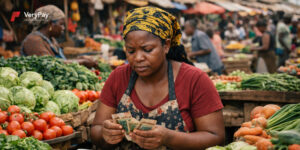
Female trader counting cash
In a bustling market in Lusaka, Amina carefully counts the small bills she earned from selling fresh vegetables. Her customers are loyal, but keeping track of payments and balancing her tiny notebook has always been stressful. She has missed opportunities before, orders lost in the confusion, money misplaced, days spent reconciling sales instead of serving her customers.
Across the border in Dakar, Mamadou, a school administrator, watches students queue up for make payments within the school ecosystem. Each transaction is a gamble: cash can go missing, receipts can get lost, and merchants grow frustrated. Meanwhile, teachers spend precious hours managing money instead of preparing lessons.
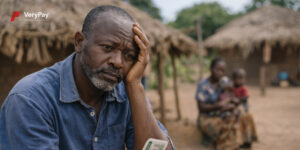
A Man in Rural Zambia
In a rural village in Zambia, Joseph, a father of three, depends on social cash transfers to cover basic needs for his family. Delays and errors in the disbursement process have left him anxious, wondering if the money he depends on will arrive on time.
These are everyday stories, ordinary lives shaped by the constraints of cash, distance, and fragmented financial systems. Yet across Senegal, Zambia, and Uganda, something is quietly changing. VeryPay has begun to weave its technology into these communities, not as an intrusion, but as a support, a tool that empowers people like Amina, Mamadou, and Joseph to thrive.
For Amina, digital payments mean she no longer has to spend hours counting cash or worrying about lost revenue. Her customers pay directly into her digital wallet, and she can track every transaction instantly. With the extra time and clarity, she can focus on growing her business, experimenting with new products, and serving her community better.
A Man in Rural Zambia
For Mamadou, schools have embraced cashless systems that allow parents to pay securely from their phones. The stress of long queues and missing payments is gone. Teachers and administrators can dedicate their energy to students, while parents rest assured that their children’s pocket money are accounted for accurately. Education becomes smoother, fairer, and more predictable, a real transformation in the lives of families and staff alike.
For Joseph, receiving social cash transfers digitally changes everything. He no longer has to travel long distances or risk delays to access the money his family needs. Payments are transparent, reliable, and trackable. For the first time, he can plan for the week ahead, ensure his children are fed, and invest in their health and education with confidence.
Across these three countries, the pattern is the same: communities that once struggled to manage cash are gaining control, confidence, and opportunity. The shift is subtle but profound. Behind it, VeryPay provides the digital rails, the invisible infrastructure that makes these transformations possible, without overshadowing the people whose lives are being improved.
This is Africa’s silent revolution. It is not driven by apps or technology alone. It is powered by traders, parents, teachers, and families taking control of their financial lives, supported by tools that meet them where they are. VeryPay is part of that story, but the story itself belongs to the people. Their resilience, their ingenuity, and their daily triumphs are what make the cashless future real.
In markets, schools, and villages across Senegal, Zambia, and Uganda, money is moving differently. Lives are changing quietly, profoundly, and for the better. This is the heart of the cashless revolution: people empowered, communities thriving, and opportunity flowing where it is needed most.




 Global
 Uganda
 Senegal
 Zambia